A no-show costs more than one table's revenue. The seat was blocked, a walk-in may have been turned away, and the team was scheduled for guests who never came. Many no-shows are not bad intent but a forgotten booking or a cancellation that never arrived — and there are ways to deal with both.
1. Why don't guests turn up?
- They forgot the booking, especially when it was made weeks ago.
- They meant to cancel but found no easy way: nobody on the phone, no way to reply to the confirmation.
- They booked in several places and decided at short notice.
- Something came up, and cancelling did not seem worth the effort.
2. What helps most?
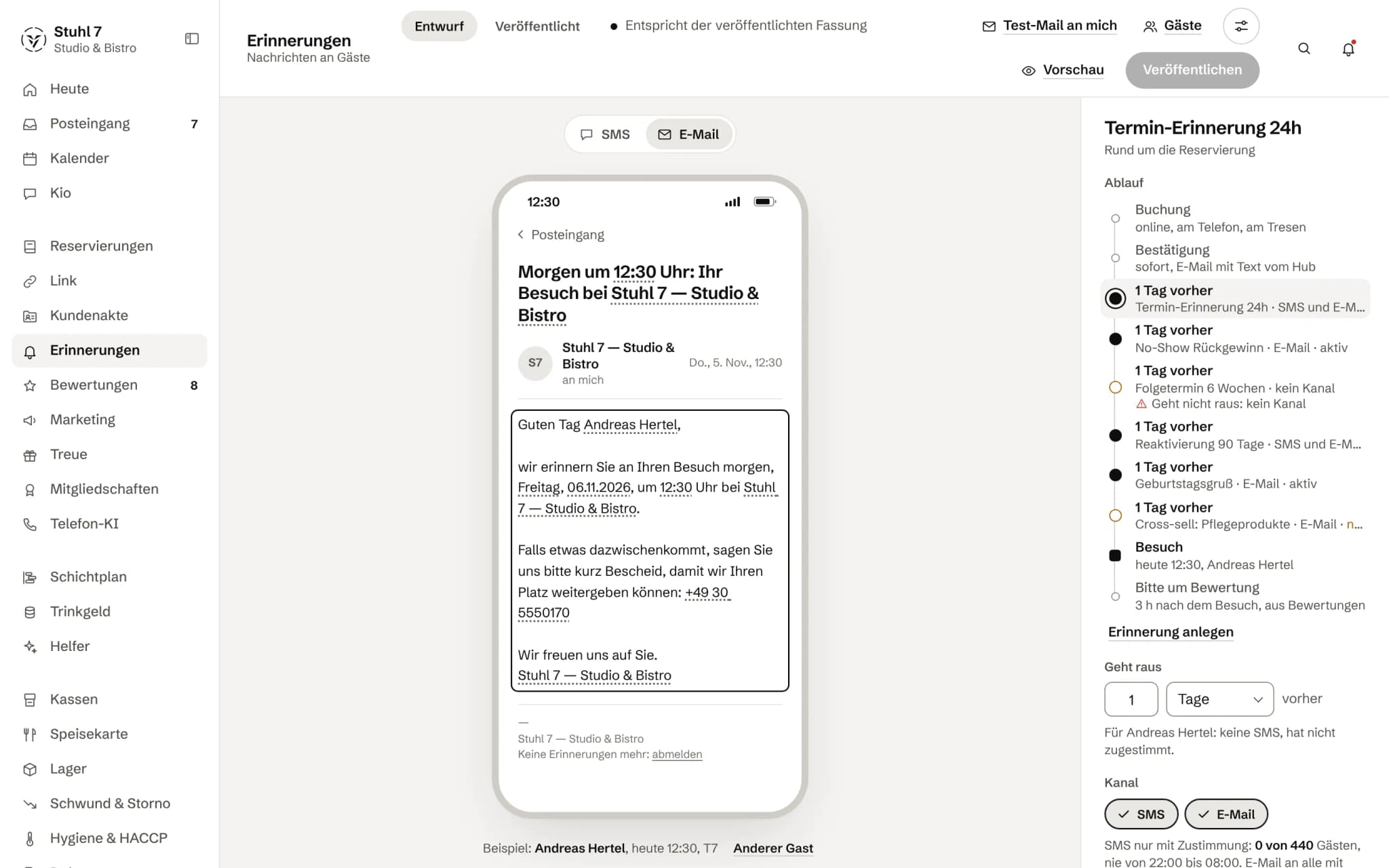
A reminder before the visit, together with an easy way to cancel. The two belong together: a reminder without a way to cancel only reminds people that they are not coming. A table freed the day before is better than one that stays empty in the evening.
When booking
Take a phone number or email address and confirm the booking in writing straight away, with date, time and party size — and the way to cancel.
Before the visit
Send a reminder early enough for the table to be given to someone else. For large groups or holidays, also ask for a short confirmation a few days ahead.
On the day
Keep an eye on bookings without a reply and have the waitlist ready. Decide how long a table is held when nobody arrives.
After service
Mark guests who did not come. Anyone who failed to turn up more than once gets a question at the next booking — not a ban made on gut feeling.
3. When is the right time for the reminder?
Early enough for the table to be rebooked, late enough that the visit is not forgotten again. For many venues that means the day before, plus a few days ahead for groups and holidays. Looking at when cancellations arrived and when guests stayed away over the last few weeks lets you set the timing for your own venue rather than by rule of thumb.
4. May the reminder go by email or text message?
A message about the guest's own booking is part of the booking. It changes as soon as the same message carries an offer, a voucher or a pointer to the next promotion: then it is advertising, and advertising by email or text message requires prior express consent under German law (section 7(2) of the Act against Unfair Competition, UWG).
5. Do deposits or no-show fees help?
For large groups, on holidays and for set-menu evenings they can, because cancelling then costs something. A no-show fee must, however, be clearly agreed before the booking; it cannot be introduced afterwards. Whether and at what level it is enforceable in a given case is a legal question and belongs with a lawyer before it appears on your booking page.
And an announced fee that is never charged changes nothing about behaviour — it only makes booking more cumbersome.
6. What if a table still stays empty?
A waitlist for the evening, with guests' preferred times and party sizes, turns a cancellation into a second chance. Add a fixed point from which a reserved table goes to walk-ins if nobody arrives — decided beforehand, stated in the confirmation and known to the team, not decided in the moment.