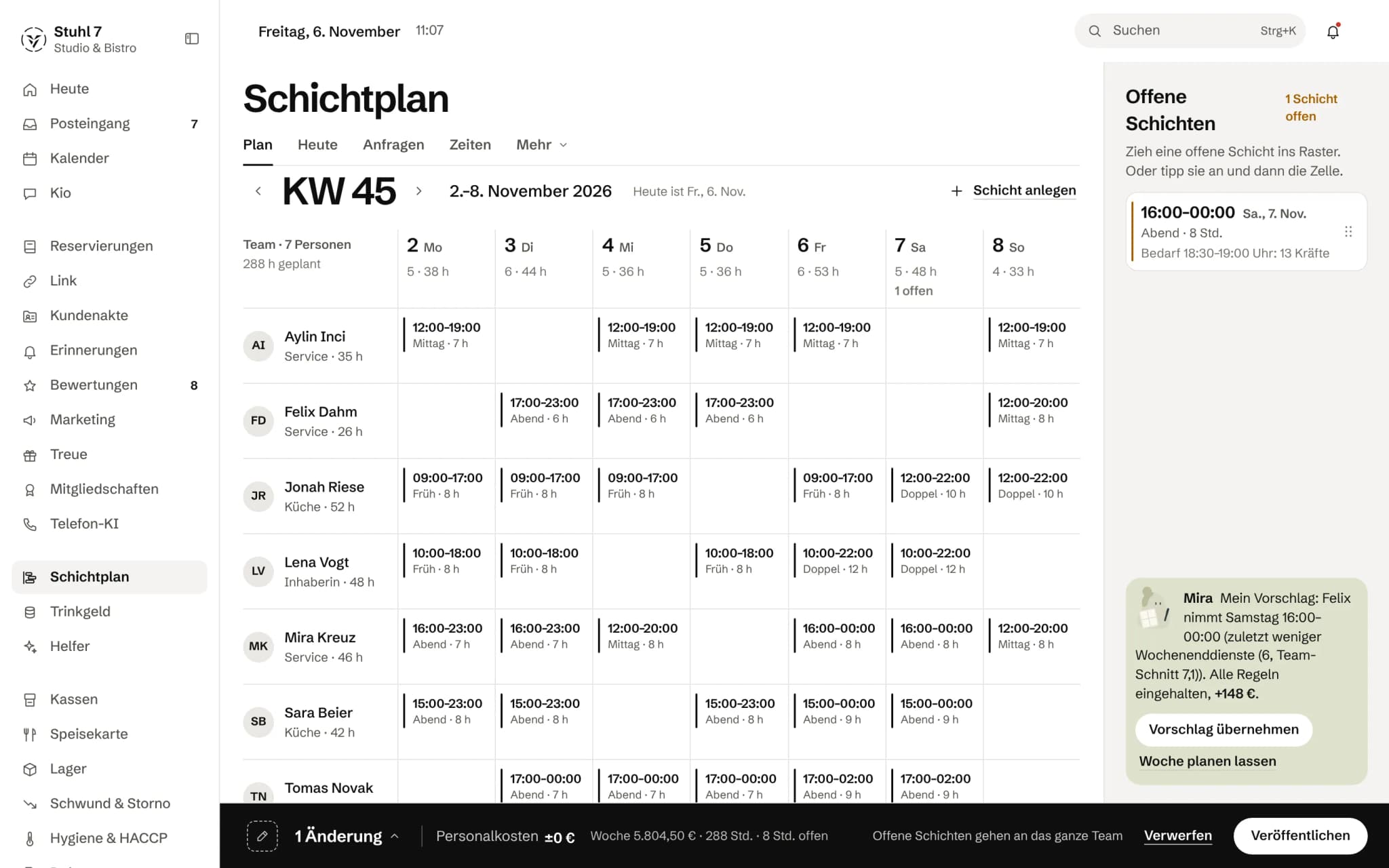
A rota is more than a table of who comes when. It has to follow rules that apply to every business, and a few that are different for hospitality. A breach is rarely deliberate. Usually the plan gets reshuffled on Thursday and nobody does the maths again.
| Rule | What applies |
|---|---|
| Working time per day | 8 hours; up to 10 if 8 hours are not exceeded on average over six months or 24 weekssection 3 ArbZG |
| Break | Over 6 hours 30 minutes, over 9 hours 45 minutes; in parts of at least 15 minutes, fixed in advancesection 4 ArbZG |
| Rest period | 11 uninterrupted hours; in restaurants and bars 10, if a 12-hour rest within a month or four weeks makes up for itsection 5 ArbZG |
| Sundays | Allowed in restaurants and bars; at least 15 Sundays a year free, substitute rest day within two weekssections 10 and 11 ArbZG |
| Records | Start, end and length, by the seventh day after at the latest; keep for two yearssection 17 MiLoG, section 2a SchwarzArbG |
| On-call work | Working hours notified at least four days in advancesection 12 TzBfG |
| Under 18 | Between 6 a.m. and 8 p.m.; over 16 in the restaurant trade until 10 p.m.section 14 JArbSchG |
1. How long may a shift be?
Eight hours per working day. It may be extended to up to ten hours, but only if eight hours per working day are not exceeded on average over six calendar months or 24 weeks (section 3 of the German Working Hours Act, ArbZG). A ten-hour Friday shift therefore has to be balanced out elsewhere.
2. When is the break due?
For more than six and up to nine hours of work at least 30 minutes, for more than nine hours 45 minutes. The break may be split into parts of at least 15 minutes, and nobody may work more than six hours in a row without one. It has to be fixed in advance (section 4 ArbZG); a break that somehow happens between two tables does not meet that.
3. How much rest is needed between two shifts?
Eleven uninterrupted hours after the end of work (section 5(1) ArbZG). Someone who works until midnight comes back at 11 a.m. at the earliest. In restaurants and bars the rest period may be shortened by up to one hour if each shortening is made up within a calendar month or within four weeks by extending another rest period to at least twelve hours (section 5(2) ArbZG).
The exception requires compensation that somebody keeps track of. A rota that regularly pairs a late shift with an early one and ten hours in between needs a record of where the twelve-hour periods are.
4. Is Sunday work allowed?
In restaurants and bars, yes: the Working Hours Act permits work on Sundays and public holidays where the work cannot be done on working days (section 10(1) no. 4 ArbZG). In return, at least 15 Sundays a year stay free, and anyone working on a Sunday gets a substitute rest day within two weeks; for a public holiday falling on a working day, within eight weeks (section 11 ArbZG).

5. What has to be recorded?
In the hospitality and accommodation sector, the start, end and length of daily working time must be recorded by the end of the seventh calendar day after the working day at the latest, and kept for at least two years (section 17(1) of the Minimum Wage Act, MiLoG, together with section 2a of the Act to Combat Undeclared Work, SchwarzArbG). The same applies to mini-jobs outside hospitality too. Independently of that, the Working Hours Act requires working time beyond eight hours per working day to be recorded and the records to be kept for two years (section 16(2) ArbZG).
The rota itself is no proof of that: it says what was planned, not what was worked.
In hospitality, employees must also carry their ID while working, and the employer has to inform them of this in writing beforehand, in a way that can be shown (section 2a SchwarzArbG).
6. How short-notice may the rota change?
For on-call work there is a fixed limit: employees only have to work if they are told when at least four days in advance (section 12(3) of the Part-Time and Fixed-Term Employment Act, TzBfG). Notice periods for everyone else, where they exist, are set in the employment contract, a collective agreement or a works agreement.
If there is a works council, it has a say in the start and end of daily working time, breaks and how hours are spread across the week (section 87(1) no. 2 of the Works Constitution Act, BetrVG). The rota is then not for management alone.
7. What applies to young workers?
For employees under 18 the Young Persons Protection Act applies, with its own, stricter rules. One example: young workers may generally only be employed between 6 a.m. and 8 p.m.; those over 16 in the restaurant trade until 10 p.m. (section 14 JArbSchG). If you schedule apprentices or helpers under 18, check their shifts against that act, not against the Working Hours Act.
8. What should be checked before publishing?
Rest period
Eleven hours between the end of one shift and the start of the next — or ten, with compensation that is tracked.
Breaks
Every shift over six hours has a fixed break, over nine hours 45 minutes.
Length
No shift over ten hours of work; days over eight hours are balanced out on average.
Sundays
Anyone working on a Sunday has a substitute rest day within two weeks.
Young workers
Shifts for employees under 18 fall within the hours section 14 JArbSchG allows.