
 Marketing
 whose effect you do not have to take on faith.
Most campaigns end with an open rate and a good feeling. Veydex Marketing answers the question that matters instead: did those guests come back because of it?
Marketing with proof.
Veydex Marketing uses the guest data your venue already holds to build targeted campaigns instead of mass mail.
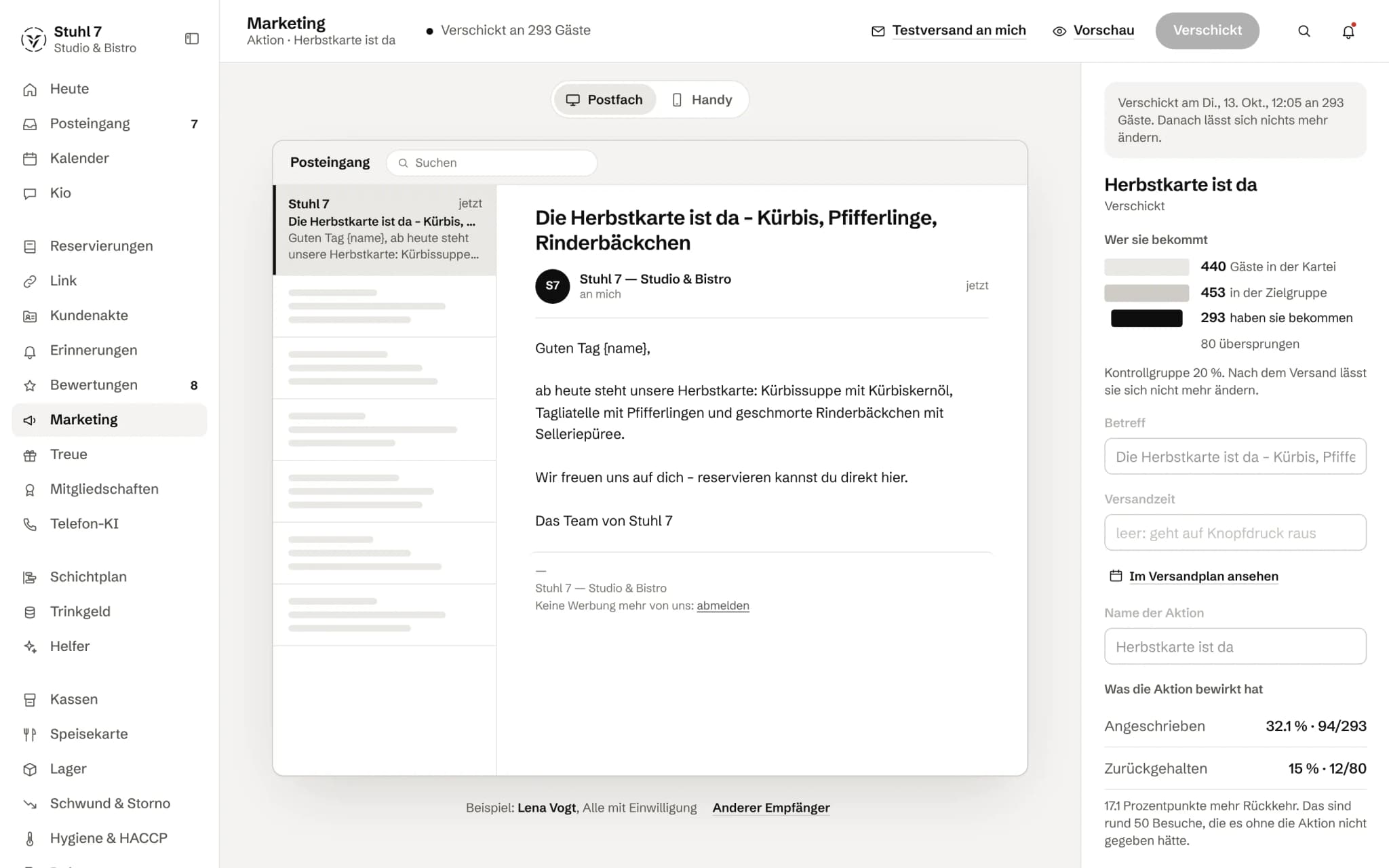
Who received it
How many received the campaign and how many were skipped.
Measured against a control group
How many contacted guests came back, and how many of those who received nothing.
More about Marketing
Segments follow actual behaviour. For promo codes you see how often they were redeemed and what they cost. And with control groups, Veydex measures on visits whether a campaign really made a difference.
A campaign with a control group
Some receive it. Others deliberately do not.
What is left at the end is not a good feeling but a difference.
- 01Veydex finds the guests who have not been in for a while.
- 02Some receive the campaign, others deliberately do not — that is the control group.
- 03Afterwards Veydex counts who from which group came back to visit.
- 04After the campaign, the difference between the two groups is a number.
What is inside.
- Customer segments
- Email campaigns
- Promo codes
- Guests at risk
- Return analysis
- Control groups
- Proof of effect
You create promo codes in the Hub and see their redemptions there. Today they are redeemed through the API; there is no button for it in the interface yet.
Ask Kio
Tell Kio. You approve.
Kio lays out the change with its reason, in the chat and in the inbox. Nothing runs until you say yes, and only the owner gets proposals.
Kio comes with every business: occasional questions are included in the Hub.
Meet Kio- You: Prepare a campaign for regulars who have not been in for three months.
- Kio:
I am laying out a campaign draft for your approval. Nothing is sent; you do that yourself afterwards in Marketing.
Create campaign draft
- Audience
- Regulars, not in for three months
Nothing happens until you approve.
Campaigns you can measure. And that only go where they are allowed.
Veydex Marketing emails guests from your guest records, finds the moment when an invitation is worth sending, and shows you afterwards whether the campaign brought guests back.
01
Audiences
At Veydex an audience is a rule, not a list that goes stale over time.
By actual behaviour
You pick guests by number of visits, by their last visit, by how long they have been a guest, by a tag from the guest record or by no-shows.
Recalculated at sending
The rule is only evaluated when the campaign goes out. Anyone who has joined or dropped out since you created it is in or out of the campaign too.
Size with consent next to it
Next to every audience you see how many guests it holds and how many of them you are actually allowed to email, meaning with an address and consent.
Preview before saving
You see the size while you are still building the rule, with a sample of the guests in it.
Blocked guests drop out
Anyone blocked in the guest record gets no marketing, whatever the rule says.
02
Win-back
When a guest has been away unusually long is measured against the rhythm of your own business.
The rhythm of your place
From the gaps between two visits of your guests, Veydex works out when a break becomes unusual. A café whose guests come every day gets a different answer from a restaurant for special evenings.
Reach out before it is too late
The list shows guests approaching that point and those who have just passed it. Frequent guests come first, and next to each one you see whether you may email them.
Counted, not emailed
Guests who have been away for a very long time are deliberately left off every list. An invitation to them brings unsubscribes rather than visits, and an unsubscribe is for good.
No guessed value
As long as there are too few visits for a reliable calculation, Veydex says so instead of estimating a moment.
03
Sending
A campaign is an email with a subject and text that goes to an audience at a given moment.
Write, test, schedule
You write the subject and text, insert the guest's name and your business name as placeholders, send yourself a test to your own address and send right away or at a set time.
The owner sends
Kio can create a draft too. Only the owner sends a campaign, after a confirmation that shows the number of recipients.
What has gone out stays as it is
A sent campaign can no longer be changed. That way it stays traceable who received which text, even a year later.
Every recipient with a reason
Each campaign has its list of recipients. Anyone skipped is listed with the reason: no consent, unsubscribed, blocked or control group.
Cancelling with an honest number
If you cancel a running campaign, the remaining emails no longer go out, and you see how many had already been delivered.
04
Effect
Whether a campaign brought guests back is measured against a group that deliberately did not receive it.
Control group before sending
A randomly drawn part of the audience does not get the email. It is drawn only among guests you may email, so both groups are comparable.
Visits instead of open rates
What is measured is who came back in the period after sending, in both groups. The difference is what the campaign achieved.
No success out of chance
If the groups are too small or the difference lies within the range of chance, it says “not measurable yet” rather than showing a small success.
Fixed once sent
The control group cannot be changed after sending. A measurement you can shift afterwards measures nothing.
05
Promo codes
Discount codes where you can see what they cost.
Percentage, amount or free item
A code gives a percentage off, a fixed amount or a free item, if you like only above a minimum spend.
Rules per code
Valid from, valid until, how often in total and how often per guest. Once a code is used up, it says so.
Redemptions booked one by one
Every redemption is recorded on its own, with guest and discount. From these Veydex works out how often a code was used and what it cost.
The code stays as printed
You can retire a code you have created, but not rename it. What is printed on flyers and in sent emails keeps working.
What it does differently. And why that matters.
Who in the business gets what out of it.
Technical details and data
Law
Marketing by email needs express consent under § 7 of the German Unfair Competition Act (UWG). Veydex only sends to guests whose guest record shows that consent, and checks consent, unsubscribes and blocks again before every single email.
Sender
Campaigns go out under your business's name, with the addition “via Veydex”. At the very bottom a small line says the email was sent through Veydex. It has no reply-to address.
Prerequisite
Marketing requires Guest records. Without profiles there are no audiences.
What is measured
Visits the Hub knows about: from reservations, appointments and visits logged by hand. Veydex does not measure revenue per guest, because a till receipt carries no name.
Helpers and Kio
From Marketing they see your business's return curve only as a figure, without names. They get no list of individual guests from there; reaching out stays in the interface, with you in front of it.
What it does not do today
Listed here so you know before, not once you are running it.
Marketing sends emails.
It does not publish posts on Instagram or Facebook.
A campaign's text is plain text with two placeholders.
Images and buttons in the text do not exist yet.
Veydex does not measure opens or clicks.
What it measures is whether guests came back.
You create promo codes in the Hub and see their redemptions there.
They are redeemed through the Hub's interface; a redeem button in the user interface does not exist yet.
Walk-in guests without a reservation, appointment or logged visit are unknown to Veydex, so it can neither select nor measure them.
Recurring campaigns, automatically triggered campaigns and A/B tests do not exist yet.
Every campaign is created on its own.
Stronger together. Marketing and the rest.
All modules work on the same data. What Marketing knows, the others know too. Switch on what you need and see straight away what it costs together.



Your selection
31 €a month
For new bookings from 1 December 2026: 36 € a month. Book or start your trial before then and you keep your price.
- Marketingfrom 1 December 2026: 24 €19 €
- Guest records · required12 €
Net. Try it for 14 days, the trial ends by itself.
Marketing costs
31 €/ month
Made up of: Marketing 19 € + Guest records 12 €
- For new bookings from 1 December 2026: 36 € a month, incl. Guest records. Book or start your trial before then and you keep your price.
- Try it free for 14 days, the trial ends by itself
- Cancel monthly, with fourteen days' notice to the end of a billing month
- No base fee, no bundle
- All prices net
Questions before you start
What businesses want to know before they switch it on.
Do I need Guest records for this?
Yes. Marketing builds its audiences from the profiles in Guest records, and without them there is nobody to email. That is why the pricing page shows the two together.
How does a guest's consent get into the Hub?
You record it on the profile once a guest has agreed; the default is no. If someone unsubscribes through the link in an email, Veydex withdraws the consent on the profile by itself.
Can I import my existing address list?
The Hub's interface has no import for address lists. The Hub's API does accept guests, but only sets consent to marketing if that is stated explicitly; by default it is off, because an address list on its own is not consent.
How do I see whether a campaign worked?
From the return rate compared with the control group. Veydex shows both rates side by side and tells you whether the difference is beyond chance. If the campaign ran without a control group, it says that this cannot be determined.
Why are some guests on no list at all?
Because they have been away for a very long time, measured against the rhythm of your business. Veydex counts them but does not suggest emailing them: an invitation to this group tends to bring unsubscribes instead of visits.
What happens if I cancel a running campaign?
Emails not yet sent no longer go out. What has been delivered stays delivered, and Veydex tells you how many that was.
Where does it go when a guest replies to the email?
Nowhere: campaign emails have no reply-to address. If guests should be able to reach you, put your phone number or the link to your page in the text.
Can I post on Instagram with Marketing?
No. Marketing sends emails to guests who have given consent. It does not publish posts on social networks.